
How to Balance Your Nervous System with Sound

There is a moment that happens in nearly every sound journey I guide.
At first, people arrive carrying the texture of modern life in their bodies. Many are caught in a subtle fight or flight response with shallow breathing, tight shoulders, racing thoughts, overstimulation, and fatigue. Some cannot fully exhale. Some do not realize they have been holding their breath for hours, days, or years.
Then something begins to soften. Not because anyone is trying to relax. Not because they are forcing themselves to meditate correctly. But because sound healing gives the nervous system something ancient and instinctive to respond to.
The body remembers resonance.
Long before we had language for stress physiology or how to balance nervous system patterns, human beings gathered around rhythm, voice, humming, drums, chanting, strings, rattles, bells, and the sounds of the natural world. We were shaped by sound. The sympathetic nervous system evolved in relationship to vibration.
And even now, beneath all the noise of modern life, the body still knows how to respond.
How to Balance Your Nervous System by Listening to the Body
The nervous system is constantly scanning the environment for cues of safety or danger. This happens beneath conscious awareness.
A harsh tone of voice, constant notifications, traffic, overstimulation, emotional tension, fluorescent lighting, and the relentless speed of modern culture can keep the body in a subtle state of activation. Many people live in chronic low-level stress without realizing it because it has become their normal.
Often this shows up as:
shallow breathing
difficulty resting
anxiety or irritability
exhaustion paired with inability to relax
brain fog
insomnia
emotional numbness
feeling disconnected from oneself
The nervous system does not simply need silence. It needs signals of safety.
This is where intentional sound healing becomes profoundly supportive.
Why Breathwork Matters for How to Balance Your Nervous System

In my own work, I rarely separate sound from breath.
Talk therapy has an important place. It gives us space to mentally process what has happened in our lives. But even when we intellectually understand our pain, the body may still be carrying the charge of it.
Our modern lives create chronic stress inside the nervous system. Trauma, fear, anxiety, overwhelm, and emotional suppression do not only live in the mind. They live in the tissues, muscles, breath patterns, and nervous system itself.
Many people are functioning while subtly bracing all the time.
Holding their breath. Clenching their jaw. Living in a constant low-grade state of vigilance.
And you cannot always think your way out of that.
This is why deep breathing is so important for how to balance nervous system patterns.
The breath is one of the most direct bridges into the nervous system. When we begin breathing more consciously, especially through slower exhales and regulated breathing patterns, the body often begins releasing stored tension and survival responses that words alone cannot fully access.
Breathwork helps dissolve the physiological charge the body has been holding.
And when breathwork is paired with intentional sound, the nervous system often responds even more deeply.
A sustained tone, a soft drone beneath the body, the resonance of bowls, monochord, harp, chimes, drum, or voice unhook the mind and bring the body into coherence.
These experiences help create conditions where the body no longer feels it must remain hyper vigilant. The sympathetic nervous system begins to settle. The body begins to trust the moment again.
Sound Gives the Mind Something to Rest Into
One of the reasons sound healing is so effective is because it gently interrupts mental looping.
The mind is often occupied with planning, remembering, anticipating, analyzing, and rehearsing. But sustained tones, resonance, rhythm, and layered harmonics invite attention away from constant thought and back into direct sensory experience.
The body begins listening instead of bracing. This shift matters.
When attention moves from mental overactivity into listening, breathing often deepens naturally. Heart rate can slow. Muscles release. The body begins moving out of survival mode and toward restoration.
Not through force but through resonance.
Sound, Pain, and the Body
Sound can also play a profound role in pain management.
Research is beginning to show that low-intensity sound may help reduce pain perception by calming neural pathways connected to the auditory system and thalamus, effectively lowering the intensity of pain signals moving through the body.
Nociceptors, the body’s pain receptors, are constantly scanning for pain and potential threats. In chronic pain states especially, the nervous system can become highly focused on those signals.
But sound gives the nervous system another sensory experience to orient toward.
Live music, resonance, rhythm, and vibration can interrupt the body’s fixation on pain by introducing a different experience for the nervous system to engage with.
This is one of the reasons therapeutic music has been used in hospitals, hospice care, oncology, surgical recovery, and palliative settings for decades.
And live music can be especially powerful.
When a harp is played gently beside a patient, when low tones vibrate through the body, when breath slows and the nervous system softens, many people experience significant pain reduction.
Sound does not merely distract the body from pain. It helps the nervous system shift its state.
The Voice: Our First Instrument
One of the most accessible instruments we have is our own voice.
Before we ever touched a drum, harp, flute, or bowl, we had breath and sound moving through the body itself.
Humming, toning, chanting, sighing, singing, and sustained vocalization create vibration directly inside the body and can be incredibly regulating for nervous system patterns.
These vibrations can help stimulate and relax the vagus nerve, one of the primary pathways connected to rest, digestion, emotional regulation, and feelings of safety.
This is one reason humming often feels calming almost immediately.
The body responds to its own resonance.
And perhaps most importantly, the voice reminds people that they do not need to be musicians to begin working with sound. The body already carries the instrument within it.
Ancient Cultures Understood the Power of Sound
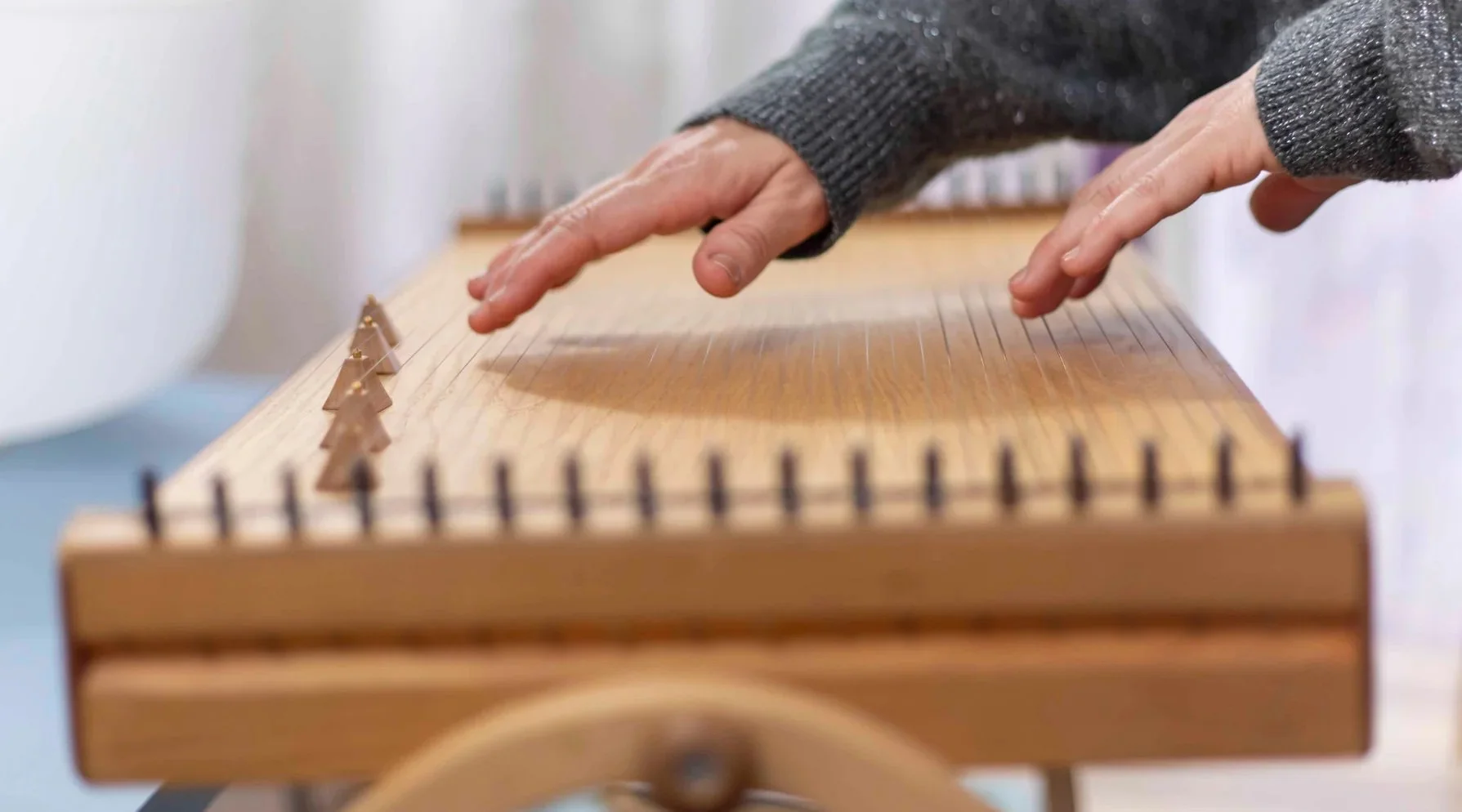
Ancient cultures were deeply aware that sound affected consciousness, emotion, and the body.
Throughout history, sound was not viewed merely as entertainment. It was understood as a force capable of restoring balance, regulating emotion, supporting healing, and shifting human experience.
In Ancient Greece, philosophers and musicians explored the relationship between music, mathematics, harmony, and the cosmos. Certain musical modes were believed to influence emotional and physical states differently.
In yogic traditions, seed syllables and vocal tones were associated with the body’s energetic centers, using vibration as a way to awaken and balance different aspects of the self.
In Qigong traditions, specific healing sounds correspond to individual organs and emotional states.
Across cultures worldwide, we find chanting, drumming, sacred singing, rattles, bells, flutes, strings, and repetitive rhythms used ceremonially to regulate the nervous system, support grief, deepen prayer, mark transitions, and reconnect people with themselves and one another.
Modern neuroscience is now beginning to explore what many ancient cultures already understood intuitively. The body responds to vibration.Returning to Ourselves
Perhaps this is the deepest reason sound matters right now.
We live in a culture that continually pulls attention outward. Many people are overstimulated, emotionally exhausted, disconnected from their bodies, and living with nervous systems that rarely experience true rest.
Intentional sound creates a different experience. It asks nothing from you except presence.
It reminds the body how to slow down. It creates space around thought.It softens the edges of overwhelm.It helps people feel themselves again.
Not fixed.Not perfected but simply returned to oneself. And often, that is where healing truly begins.
At Mongata, sound is approached not as performance or escape, but as a contemplative practice of listening — a way of gently returning to balance, breath, presence, and inner coherence.
If you are longing for a softer, more grounded way of being in the world, you are warmly invited to explore Mongata’s sound journeys, breathwork experiences, guided meditations, and restorative sonic offerings.
Because beneath the noise of the world, the nervous system is still listening for resonance.
Returning to Ourselves
Perhaps this is the deepest reason sound matters right now.
We live in a culture that continually pulls attention outward. Many people are overstimulated, emotionally exhausted, disconnected from their bodies, and living with nervous systems that rarely experience true rest.
Intentional sound creates a different experience. It asks nothing from you except presence.
It reminds the body how to slow down. It creates space around thought. It softens the edges of overwhelm. It helps people feel themselves again.
Not fixed. Not perfected. Simply returned to oneself.
And often, that is where healing truly begins.
At Mongata, sound is approached not as performance or escape, but as a contemplative practice of listening, a way of gently returning to balance, breath, presence, and inner coherence.
If you are longing for a softer, more grounded way of being in the world, you are warmly invited to explore Mongata’s sound journeys, breathwork experiences, guided meditations, and restorative sonic offerings.
Because beneath the noise of the world, the nervous system is still listening for resonance.
