
Reflections from Scotland on music, friendship, and the songs that connect us to the places we love.
Greetings!
I've been off traveling! I've recently returned from Scotland, one of my favorite places in the whole world. I spent nearly two weeks playing harp, exploring beautiful places, enjoying old friendships, and making new ones.
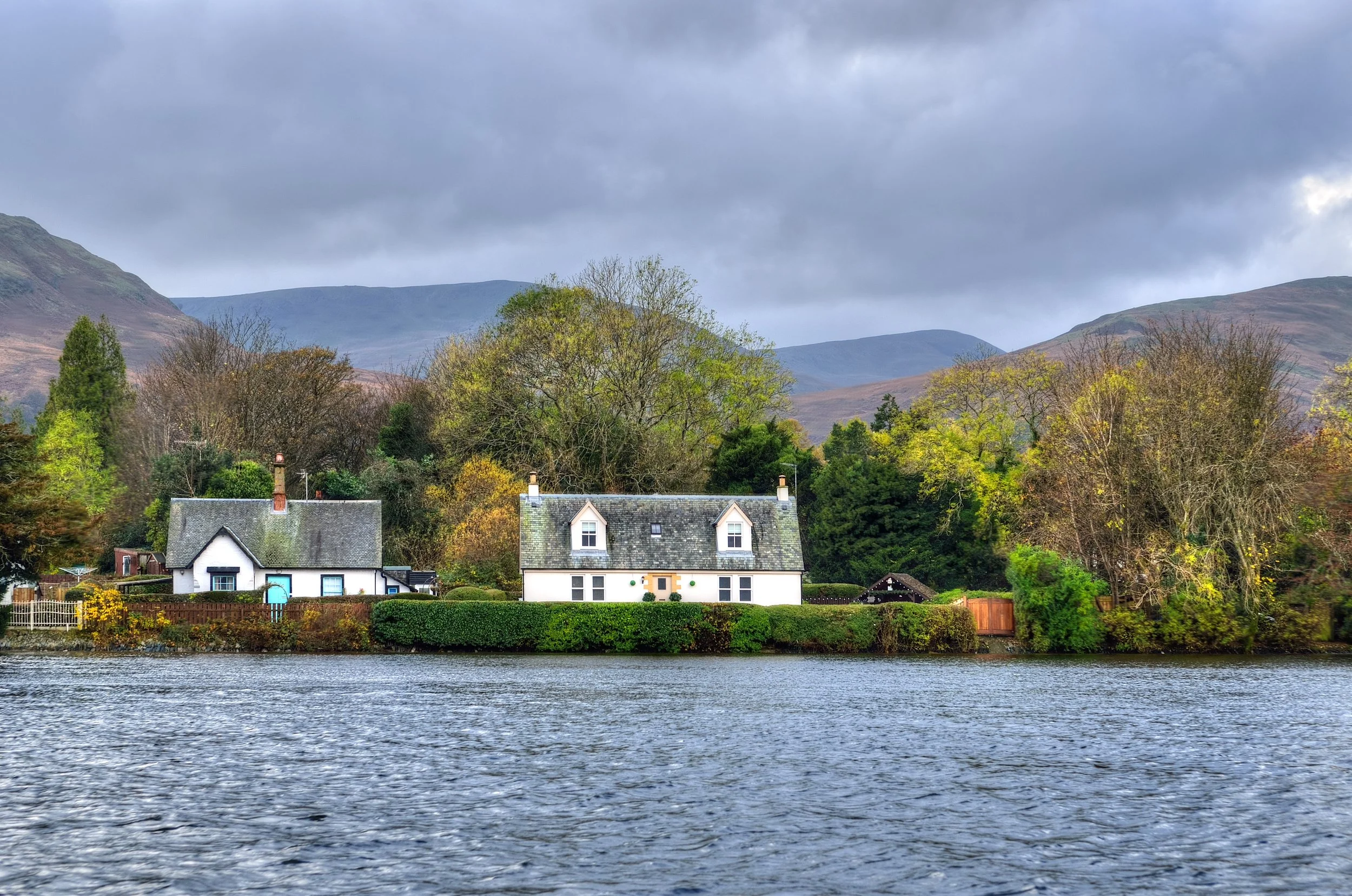
I love going to Scotland!! There's something about the landscape, the music, the people, and even the weather that makes me feel wonderfully at home. This particular journey began on the shores of Loch Lomond in Balmaha, where a small group of us gathered at the Oak Tree Inn before the How to Harp retreat officially began. Scotland welcomed us with weather that was, well, absolutely dreich. (I love this Scottish word for miserable weather.)
The wind howled, the rain blew sideways, and sometime during the night, while I was tucked into bed listening to what sounded like the building was coming apart, the wind sent the outdoor deck furniture flying into the yard. I remember lying there wondering what on earth was happening. The next morning, when I opened the blinds, there was the furniture scattered across the lawn. Welcome to Scotland!!!
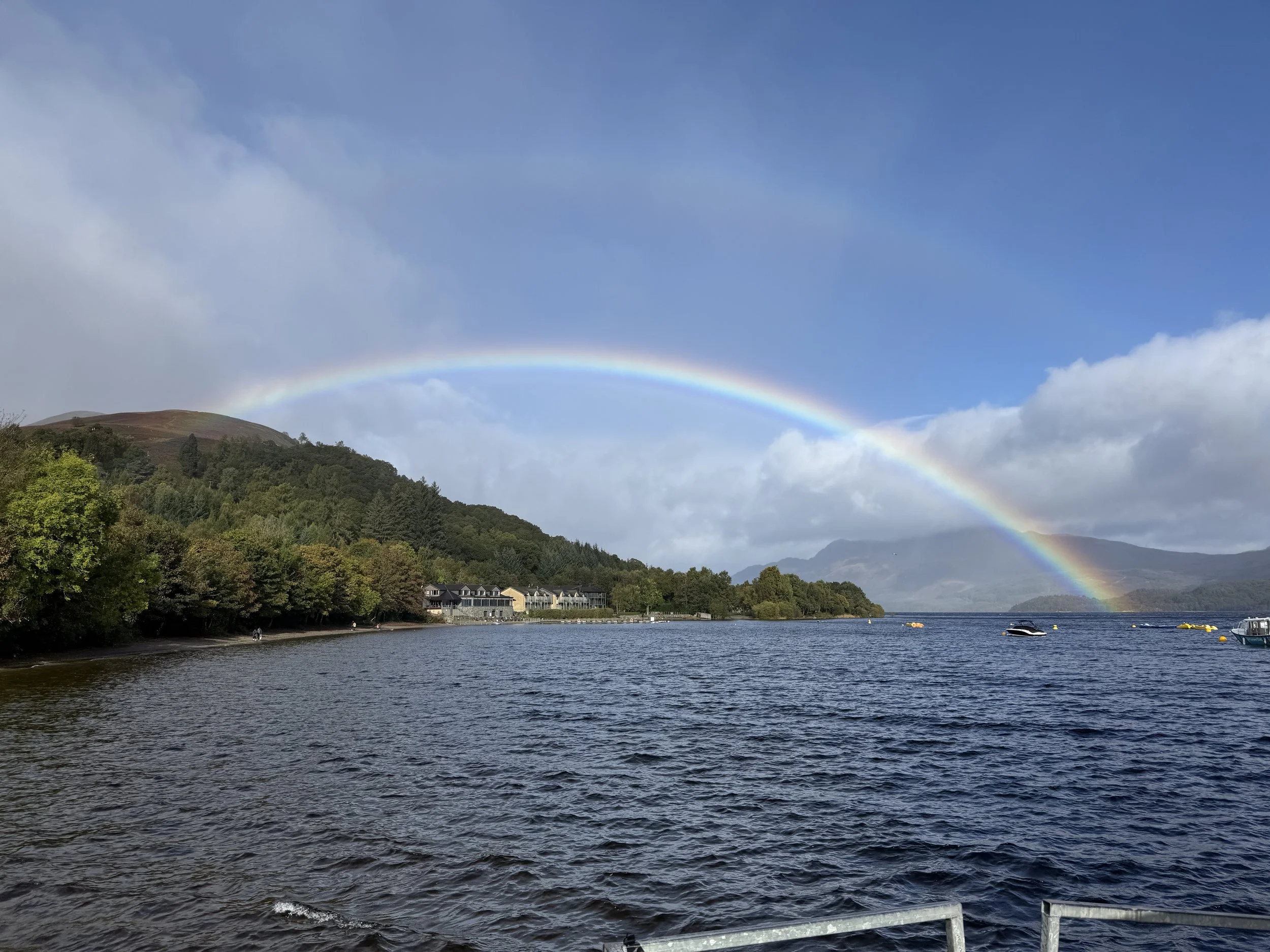
We had planned a boat trip across Loch Lomond that Saturday morning. As we walked from the inn down to the pier, the wind was still howling and the rain was coming at us from every direction. And then something extraordinary happened. The moment we boarded the boat, the rain stopped. Not only did it stop, but rainbows appeared. Not just one or two. They were everywhere, stretching across the loch in the most beautiful colors. It was magical!! We crossed the water to the little village of Luss, where we enjoyed lunch, wandered through the village, and did a little shopping before returning to Balmaha.
The High Road and the Low Road
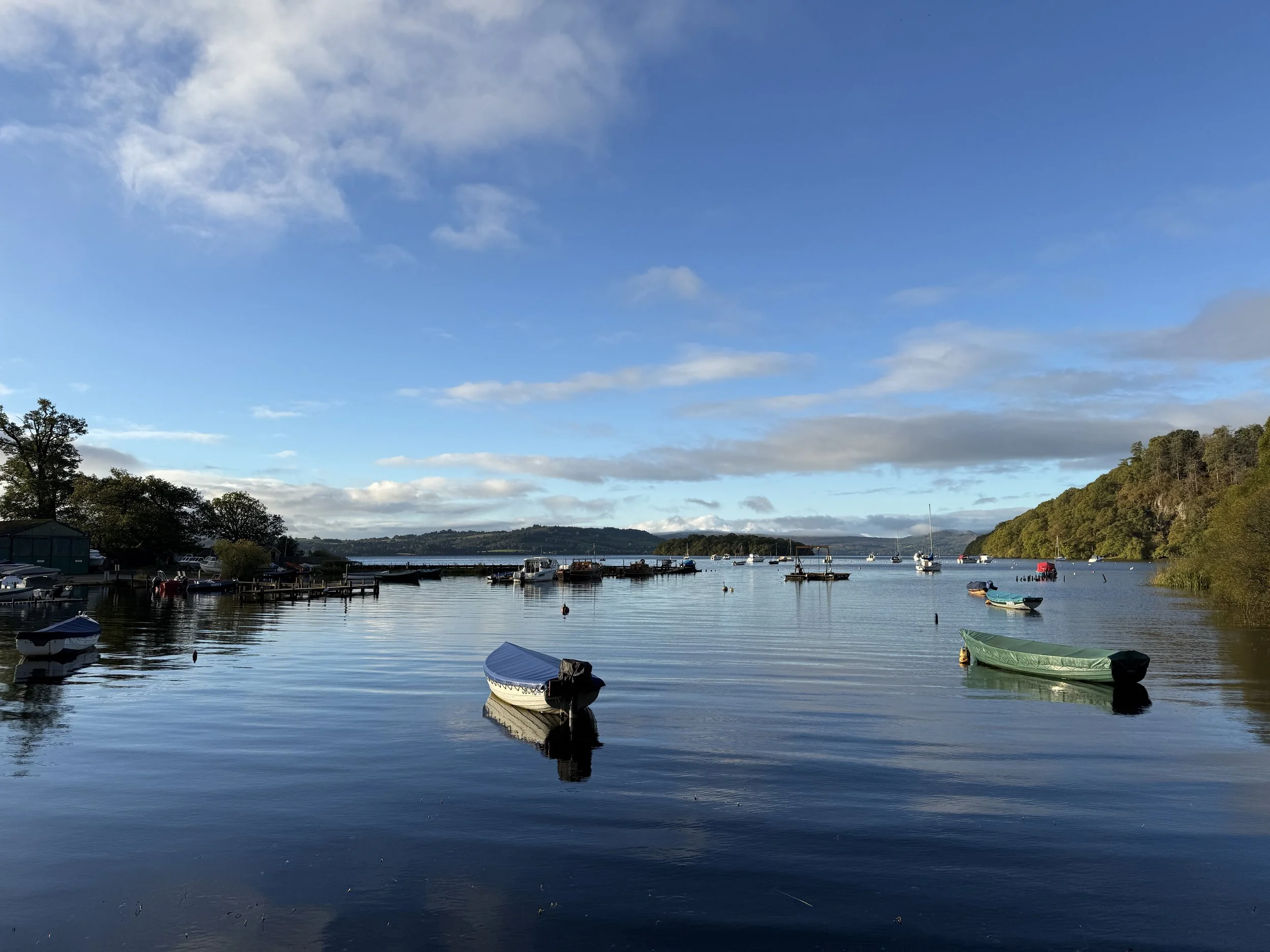
On our return journey, the boat captain shared a story about the famous Scottish song Loch Lomond. I've known this song for years. I've sung it, listened to it, and loved its beautiful melody. But I must admit, I never really understood the meaning of the high road and the low road. What exactly were those roads? I thought perhaps there was some cultural meaning or language I wasn't familiar with, because those particular words never made much sense to me.
Well, I was in good company because the captain told us an old story associated with the Jacobite uprising of 1745. According to the story, two young Scottish men had gone off to fight and were captured by the English. One would be allowed to return home to Scotland, while the other would be put to death. The young man who was to die told his companion that he could take the high road, the earthly road leading home to Scotland. He, however, would take the low road, the road through the Otherworld.
In the folklore associated with the song, fairies carry the souls of those who die far from home back to Scotland. Because the Otherworld isn't bound by ordinary time and distance, the young man who dies will arrive home before his living companion. But there is sadness in his homecoming because he will never again meet his true love on the banks of beautiful Loch Lomond.
As I listened to the captain, I suddenly understood the song in an entirely different way. What I had always heard as a beautiful Scottish melody became something much deeper, a song of longing, love, death, and homecoming. What moved me almost as much as the story itself was hearing it told by a boat captain as we crossed the very waters named in the song. Here was someone carrying a piece of his homeland's musical tradition, sharing it with travelers as he went about his day. The song was no longer separate from the landscape. We were inside it.
A Gathering of Harps
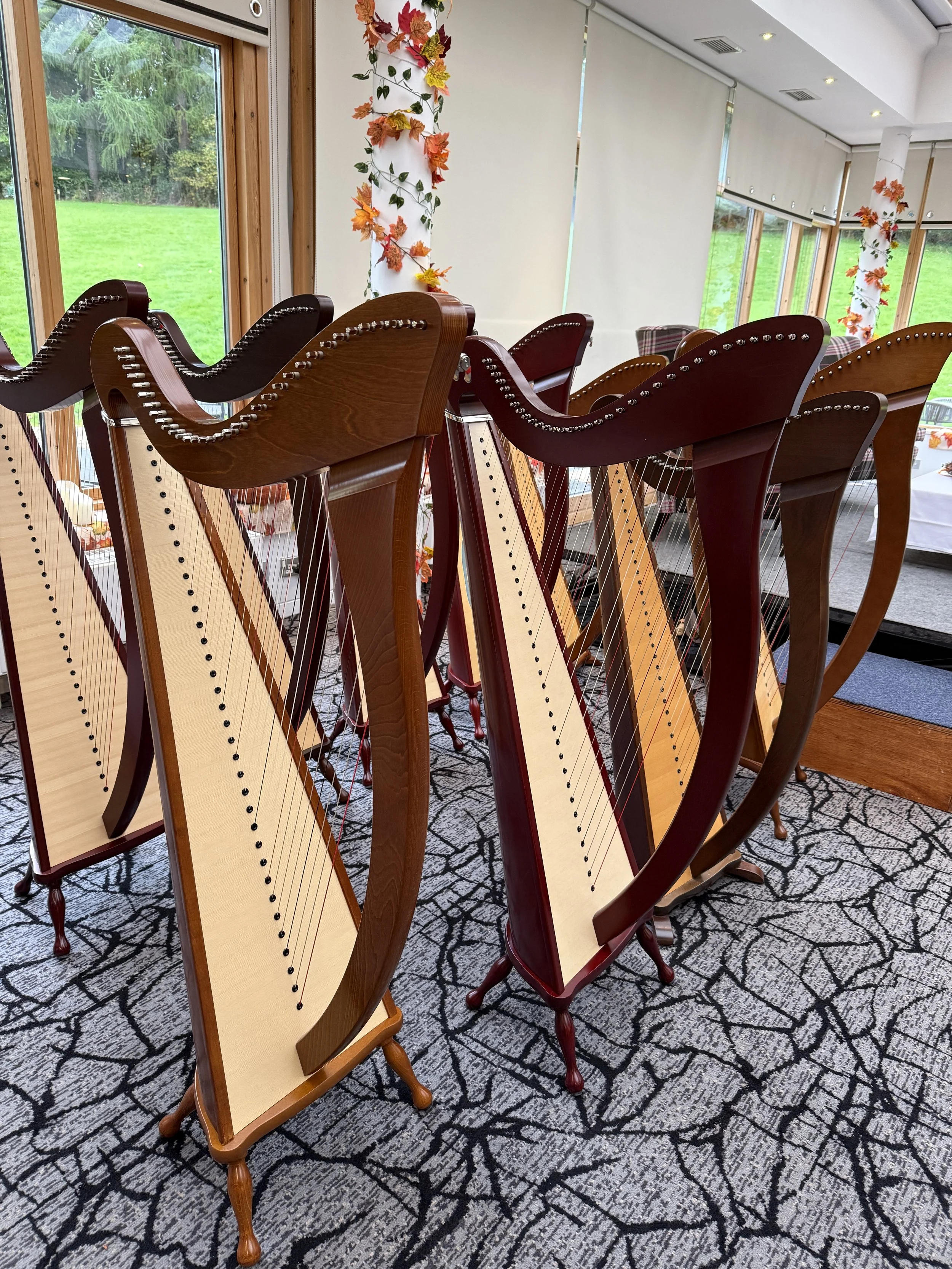
From Loch Lomond, our journey continued to Stirling, where harpists gathered for the How to Harp retreat. For one whole week, we lived and breathed harp music. We studied with wonderful tutors, attended workshops, learned new songs and techniques, explored different musical traditions, listened to performances, and spent hours making music together. Imagine being surrounded by people who love the same instrument you do! Harps everywhere! There was even a wonderful Camac harp display where we could try different instruments and perhaps buy one if we fell completely in love with it.
One of my favorite parts of the retreat was our evening music sessions. People gathered with their harps, but there were also guitars, drums, flutes, and singing. As far as playing levels, we were a mixed bag, and that was the wonderful thing about it. Nobody expected perfection. You played what you could. Some of the pieces I had prepared before leaving home, while others were completely new to me. Sometimes I simply played the melody and joined in. We were there to make music together, and it was so much fun. Those evenings were truly one of the highlights of the retreat for me.
Coming from a lifetime of classical piano study, this has been one of the great gifts of learning traditional harp music. I've spent much of my musical life reading scores, practicing, and working toward polished performances. All of that has its place, of course, but traditional music has taught me something different. It's about relationships. The relationship between the musician and the instrument, between the teacher and the student, and between the song and the people who have carried it through generations. One of the most important connections for me is the relationship between music and the land from which it comes.
As a therapeutic musician, I spend a great deal of time thinking about how music meets us where we are and how it can offer companionship, comfort, and a way of being present with ourselves and one another. Those evening gatherings reminded me that music doesn't always need an audience or a purpose beyond the simple joy of making it together. There is something wonderful about sitting in a room full of people who are listening to one another, finding their way through a melody, and enjoying the experience without worrying about getting every note right.
The friendships were just as wonderful as the music. I finally met women I'd been playing alongside in our online How to Harp gatherings. One of them, Libby, lives only about half an hour from me in Connecticut. We discovered that we even knit at the same yarn shop every week, just on different days! Through Libby, I've since been introduced to more harpists and music circles here in New England. How crazy is that? I traveled all the way to Scotland and came home with new friends who practically live down the road. Isn't life funny that way?
A Song for Two Shores
After the retreat, I returned to Glasgow for a couple of days before flying home. My hotel was right across the street from the River Clyde, and each morning I would go down to the river and spend a little time there. Sometimes I sat quietly watching the water, and other times I would meet someone interesting.
One morning, I met an older gentleman who began telling me about the Clyde. He spoke about how the river flows through Glasgow, how much it knows about the people who have lived along its banks, and how its waters eventually make their way toward the Atlantic Ocean. I loved the way he spoke about the river, not simply as a geographical feature, but almost as an old companion who had witnessed generations of human life. I kept thinking about that conversation, and before I left Scotland, an idea came to me.
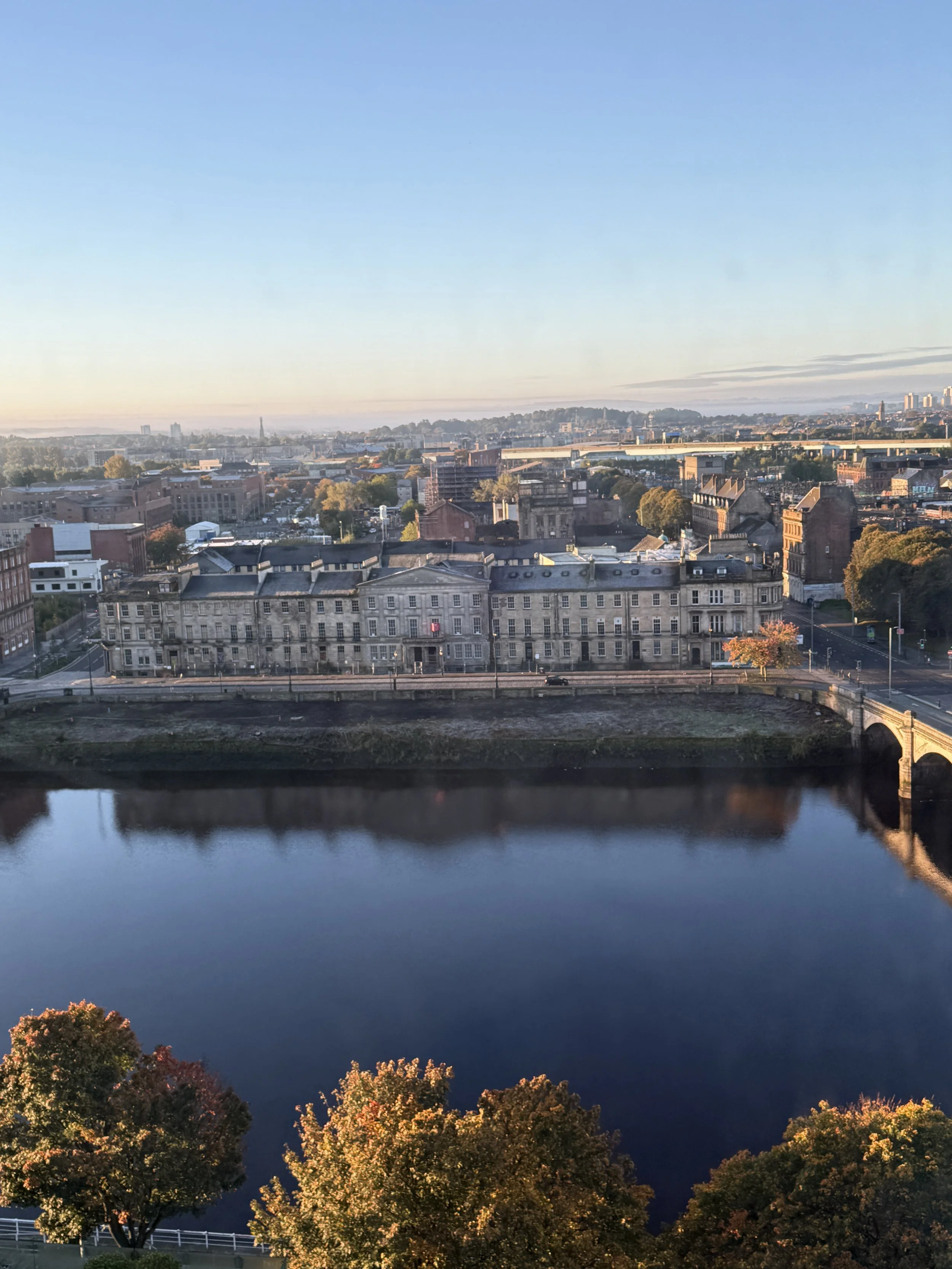
I would go down to the River Clyde and sing The Parting Glass as a way of thanking Scotland for the wonderful time I'd had. The Parting Glass is a traditional farewell song, one I've loved for many years, but the idea didn't stop there. If the Clyde's waters eventually reached the Atlantic, and I live beside the Atlantic Ocean in Connecticut, why not sing the same song when I returned home? I could sing it on both sides of the ocean. I told Heather Downie, founder of How to Harp, that I could meet myself coming and going. So that's exactly what I did.
On the morning I left Glasgow, I went down to the River Clyde and sang The Parting Glass. I sang to the water, thanking it for the beautiful days I'd spent in Scotland, for the music, the friendships, and all the experiences I'd been given. The following morning, back home in Connecticut, I made my way to the Atlantic Ocean near my house and sang The Parting Glass again.
Two shores, one ocean, and one song.
There was something deeply meaningful about standing beside the same great body of water, thousands of miles apart, carrying the same song. The song became a thread connecting the two places. I hadn't planned any of this before arriving in Scotland. The idea simply came to me, and I followed it. Looking back, I realize that I had created a small personal ritual of gratitude and homecoming. Nothing elaborate, no special preparation, just a song, two places, and a desire to acknowledge what the journey had meant to me.
Perhaps that is one of the things I love most about music. It gives us a way to express what we sometimes cannot put into words. We can use a song to celebrate, to remember, to grieve, to give thanks, or simply to acknowledge that something meaningful has happened in our lives. The music doesn't have to be complicated, and we don't have to be accomplished singers or musicians. Sometimes the simplest melody, offered with intention, is enough.
Music as a Companion Through Life
A few weeks after returning home, I had the pleasure of joining Heather Downie for a podcast conversation about my musical journey. Heather and I had such a wonderful time together at the retreat. We connected immediately, discovered that we're rather kindred spirits, and laughed a lot!!
Our conversation wandered through my lifelong relationship with music, from my early years studying classical piano to my work as a sound therapist and therapeutic musician, and eventually to my adventures learning the harp. We talked about the joy of making music, the importance of community, and why I believe music is so much more than playing the correct notes.
One of the things I shared with Heather is that I think of the harp as a threshold instrument. By that, I mean an instrument that can accompany us through the important transitions of life. A birth, a wedding, a time of illness, a period of grief, or the end of life. These are moments when words aren't always enough, and music can offer a gentle presence. It doesn't have to fix anything or change what is happening. Sometimes its greatest gift is simply to accompany us.
This understanding has become an important part of my work at Mongata. Whether I'm playing harp, offering a sound immersion, or simply sitting with someone in a quiet moment, I return again and again to the importance of listening. Listening to the music, to the person, and to what the moment is asking of us. I think this is one of the reasons I've been so drawn to traditional music and the ways it has been woven into everyday life for generations. Music belongs to all of us, and it can accompany us through so many different experiences.
Heather and I also talked about Scotland, of course, and I shared the story of singing The Parting Glass beside the River Clyde and again when I returned home. I even played the song on my harp. I'd love to share our conversation with you.
Heather Downie chats with learner harpist Valarie Budayr, a lifelong pianist who sat down at the harp, couldn't find the black keys and had to forget what she knew. It's a warm, funny conversation between kindred spirits, with a few good stories along the way.
The Songs We Carry
I've been thinking quite a bit about that boat captain on Loch Lomond and the older gentleman beside the River Clyde. Neither of these men knew how much their words would stay with me. One helped me hear a familiar song in an entirely new way, while the other inspired me to carry a song across an ocean. Both reminded me that music is deeply connected to place, memory, and the people who carry it.
Songs hold grief, love, longing, and belonging. They travel with us, sometimes for generations, gathering new meanings along the way. Sometimes, when we sing them in the places from which they came, something changes in the way we hear them. Other times, we carry them somewhere new and discover that they have become part of our own story.
When I think about my journey to Scotland, I remember the rainbows over Loch Lomond, the sound of harps filling a room, the laughter of new friends, and the waters of the River Clyde. I think about the young man in the story taking the low road home to Scotland, and I think about standing on the Connecticut shoreline the following morning, singing the same farewell song I had sung in Glasgow. It was truly a full-circle moment, one that brought together so many things I love about music, tradition, and the places we call home.
The distance between those places suddenly didn't feel quite so great. Perhaps that's one of the gifts of music. It gives us a way to carry the places we love with us, to honor the moments that matter, and sometimes, to find our way home.
